
The 2026 Workplace Dictionary:
8 Terms That Show the Old Career Deal Is Gone
Each year, new workplace terms appear, and they seem to get more negative. This happens for a reason. When many people go through something that does not have a name, a new word is born. Recently, the main shared experience is clear: the old career deal is over.
The eight terms below describe what work looks like in 2026. Each is important to know. Notice that all of them are about coping with the system, not building something new. There is a big difference between just surviving a broken deal and choosing to leave it behind.
- Job Hugging
People are keeping their jobs because they are afraid, not because they feel loyal. Workers who might have left two years ago are now staying. Hiring seems stuck, and switching jobs feels risky. The Bureau of Labor Statistics says the quits rate was 2.0 percent in June 2026, with about 3.2 million people leaving jobs by choice that month. That is much lower than the 3.0 percent peak in 2022. Fewer people are changing jobs, and it is not because they are satisfied.
- Quiet Cracking
This is burnout that happens slowly. Instead of a sudden breakdown, people gradually lose interest. You see it in lower performance and a quiet desire to be elsewhere. Gallup’s 2026 report found employee engagement in the U.S. and Canada was 36 percent. Globally, engagement dropped to 20 percent, the lowest since 2020. So, about two out of three North American workers are not engaged at work.
The Great Flattening
Companies are removing entire layers of middle management, and automation is making this happen faster. Supervisor jobs that used to reward years of hard work are disappearing. Challenger, Gray & Christmas reported that 26 percent of job cuts in April 2026 were due to artificial intelligence. That was 21,490 out of 88,387 cuts that month. For the second month in a row, AI was the top reason for layoffs. The steps people used to climb in their careers are being taken away.
- Ghost Jobs
These are job postings that companies do not actually plan to fill. They stay online to gather resumes or make the company seem like it is expanding. This shows up in national data. In June 2026, there were 7.4 million open jobs, but hiring and quitting rates stayed the same. A high number of openings does not mean there are real opportunities. That is why so many applications get no response.
- Career Cushioning
This means preparing to leave your job while you are still working there. People update their resumes, talk to recruiters, and keep their options open. In the past, this seemed disloyal, but now it is just smart planning. The Bureau of Labor Statistics says the median job tenure is now 3.9 years, the lowest since 2002. When most people stay less than four years, planning your next move is just practical.
- Task Masking
This is also known as productivity theater. It means looking busy instead of actually being productive. It includes sending messages at the right time, filling your calendar with meetings, and making sure you are seen at the office. Task masking happens when companies care more about activity than real results. It is not about being lazy. It is a smart way to respond when people are judged by appearances.
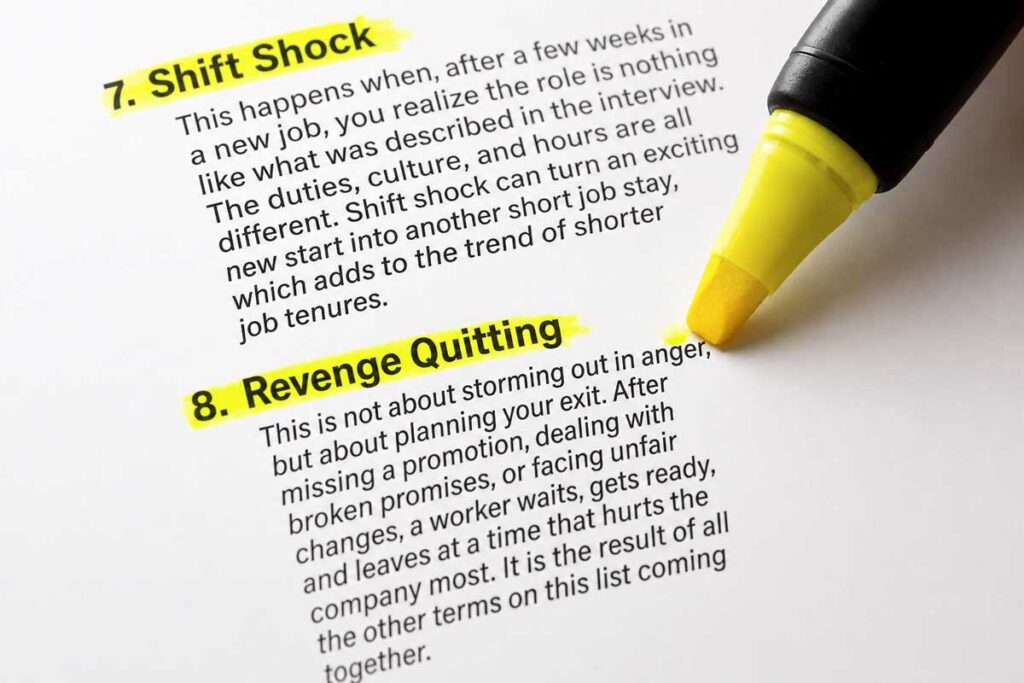
- Shift Shock
This happens when, after a few weeks in a new job, you realize the role is nothing like what was described in the interview. The duties, culture, and hours are all different. Shift shock can turn an exciting new start into another short job stay, which adds to the trend of shorter job tenures.
- Revenge Quitting
This is not about storming out in anger, but about planning your exit. After missing a promotion, dealing with broken promises, or facing unfair changes, a worker waits, gets ready, and leaves at a time that hurts the company most. It is the result of all the other terms on this list coming together.
What the List Actually Describes
When you look at these eight terms together, they all describe ways to get through things workers cannot control. None of them offer a path forward. That is the real message. The way we talk about work has become focused on coping.
 Financial stress makes it even harder to leave a job. Bankrate’s January 2026 survey found that 53 percent of Americans could not pay a $1,000 emergency from savings. Another 68 percent said they would worry about paying bills if they lost their main income. When the numbers are this tight, feeling stuck is not just a mindset issue.
The Alternative Is Ownership, and the Method Matters
More people are choosing to leave traditional jobs entirely. The U.S. Census Bureau reported 578,926 new business applications in July 2026, an 8.1 percent increase from June. The desire to start something new makes sense, but the real risk is in how someone goes about it.
Starting a business from scratch means you have to build everything yourself: the brand, systems, vendors, pricing, marketing, and hiring. Every mistake is your own to discover and pay for. Leaving an unstable job for a new business does not remove uncertainty. It just means trading one kind of risk for another, without a safety net.
Franchising is different. As a franchise owner, you join a business model that is already built and tested, often in many locations and through different economic times. There is a playbook, training, supplier deals, technology, and a brand name that attracts customers from day one. You still have to work hard, but you are not creating the business from scratch while running it.
Franchising is growing on a large scale. The International Franchise Association expects there will be about 845,000 franchise locations in 2026. These businesses should employ nearly 8.9 million people and generate $921.4 billion in output. Child services and commercial and residential services are the fastest-growing areas, each growing by 3.2 percent year over year.
Franchising is not without risk, and no honest advisor would say otherwise. The difference is in the type of risk. Starting from scratch means betting on a new idea. Franchising means betting on a proven model. Both require hard work, but only one gives you a roadmap.
Where a Career Ownership Coach® Fits
It is easy to see the problem, but making the right choice is hard. Most people thinking about owning a franchise do not have a good way to compare hundreds of brands. They cannot easily figure out which investments fit their finances.
A Career Ownership Coach® helps people make these decisions. The process starts by setting clear income goals, lifestyle needs and understanding risk tolerance. Then comes learning about franchise categories that most people have never heard of, since they only know the businesses, they see every day. After that, it is time for due diligence. Candidates learn what questions to ask and speak directly with current franchisees to find out what ownership is really like.

Franchise Match connects future owners with expert guidance and opportunities that fit their goals. Unlike self-guided directories, the focus here is on supporting people through the decision-making process.
A Different Set of Words
The list of workplace terms will keep getting longer, because the reasons behind them have not changed. New words will appear next year to describe the same problems.
But you do not have to use this vocabulary. People who choose ownership do not need words for coping anymore. They are no longer living with someone else making decisions about their future. Exploring this path only takes a conversation. It begins with honestly asking if franchise ownership is even the right fit for you
Connect with a Coach:
Take our Mindset Assessment and see if you are ready for Ownership: