
Flexibility Isn’t Freedom When Someone Else Can Take It Away.

The remote-work debate was never really about location.
It’s about control — and AI is about to make that impossible to ignore.
For five years we’ve argued about whether people should work from home or head back to the office. It can feel like the defining question of our time — but it may be the wrong question. The real issue is who controls your time, your location, and your future. And AI is about to bring that into sharp focus.
Let’s look at where things actually stand.
Remote work is here to stay — but it was never yours to keep.
Working from home is still common. In early 2026, about a quarter of all paid workdays in the U.S. were remote (Stanford WFH Research, 2026) — far above the 5–6% before 2020. Hybrid schedules are now normal for millions.
People value it, too. In a 2026 survey, 69% of remote workers said their work-life balance improved over the past year, with Gen X most likely to unplug after hours (CoworkingCafe Remote Work Well-Being Survey, 2026).
But here’s the catch. More employers are enforcing return-to-office rules — one estimate says 83% of CEOs expect everyone back by 2027 (KPMG, 2026), even as badge and phone data show workers aren’t coming in as often as expected. The flexibility you enjoy isn’t really yours. It’s a perk your employer can grant or revoke at will. And AI is about to make that even clearer.
AI shifts the question from “where” you work to “whether” your work is needed.
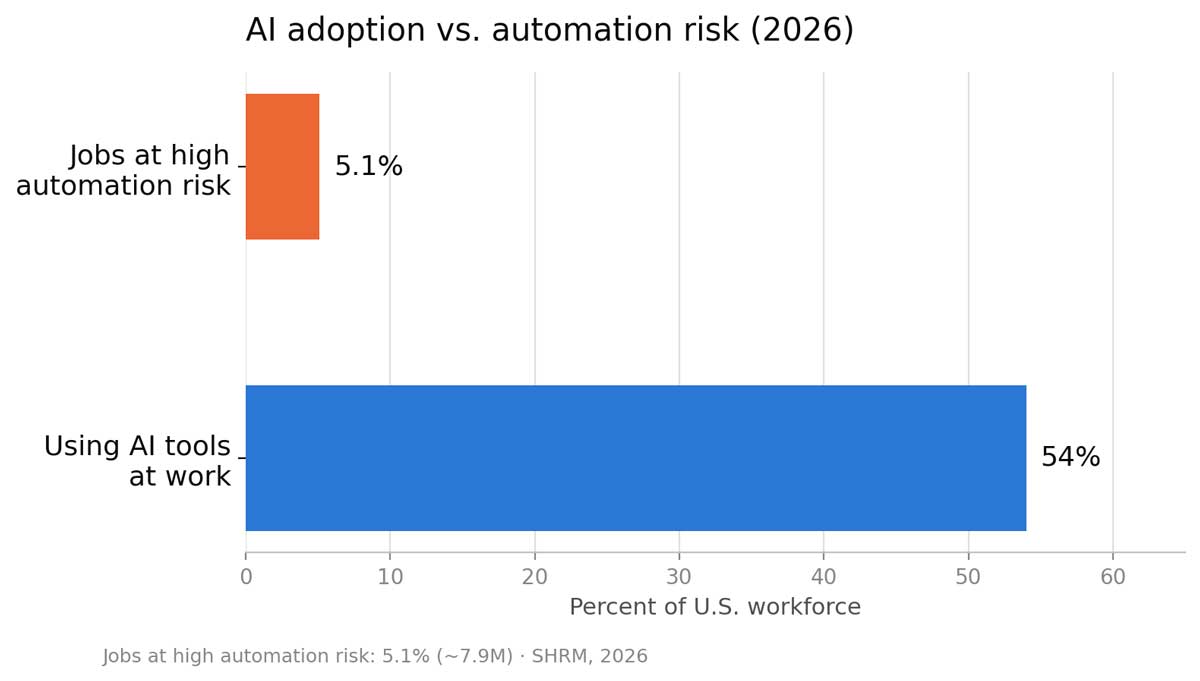
For years the worry was location. Now it’s the work itself. AI is very good at routine, repeatable tasks — data entry, basic coding, simple reports, everyday office work. More than half of U.S. workers (54%) already use AI tools on the job (2026), and a 2026 study found about 5.1% of U.S. jobs — roughly 7.9 million — are at high risk of automation (SHRM, 2026). The roles most exposed are “execution-only.”
Here’s what changes everything: AI doesn’t care where you work. Working from home won’t save a job software can do, and returning to the office won’t protect it either. Location was never the real protection. Value is.
The safest work needs judgment, trust, and ownership — the things a machine can’t copy. Tasks can be automated; direction cannot. So the question quietly becomes: “Am I doing something a machine can replace, or something only I can lead?”
That’s why so many workers feel uneasy. In the Career Ownership Coach® network’s Generational Career Confidence Survey, 61% of Americans said owning a business is the best way to protect their career from being replaced by AI. They aren’t chasing comfort. They want control.
Three paths, three very different choices.
So what are your real options? Compare three through a simple lens — I.L.W.E.: Income, Lifestyle, Wealth, and Equity.
- The in-office employee. Steady income, but with a ceiling. Your location and hours are set by policy, and your lifestyle bends around a commute you don’t control. You build wealth slowly through salary and build no equity of your own — the value you create belongs to someone else. If your role is execution-only, AI raises the risk.
- The remote employee. Often a better lifestyle — you skip the commute and reclaim time. But income, wealth, and equity look much the same, and the flexibility is temporary. A single new policy can send you back. You may feel freer without actually having more control.
- The franchise owner. This path changes the equation. You choose your hours, your location, and your pace. Your income isn’t capped by a pay grade. You build wealth and equity you own and can pass on — and AI becomes a tool you use rather than a threat you fear. The risk is real, but it’s a risk you choose and manage, not one handed to you.
Franchising: ownership without starting from scratch.
Owning a business doesn’t have to mean building one from nothing. Franchising lets you step into a proven brand and system — with training and a support network behind you — while still owning what you build. It’s one of the most accessible ways to move from “employee waiting on a policy” to “owner making the call.”
Let your goals guide you — not a corporate memo.
 Too many people let an employer’s policy decide their time, location, and freedom. A single return-to-office email can reshape their whole life. That’s a lot of power to give away.
There’s another way to decide start with what you actually want. A Career Ownership Coach® helps you get clear on your goals first — the income you need, the lifestyle you want, the wealth and equity you hope to build — and then compare every path against those answers, including options you may not have considered. The experience, relationships, and judgment you’ve built over the years aren’t baggage. They’re your greatest assets.
With Career Ownership Coaching, you move step by step, at no cost and with no pressure. Working with a Career Ownership Coach® is completely free — not just a first session, but the whole journey. The goal isn’t to push you toward any answer; it’s to make sure the answer is truly yours.
The real question.
The office-versus-home debate will keep making headlines, and AI will keep reshaping which jobs last. But the deeper question isn’t where you work — it’s who decides. You can let a policy decide how you spend your time, or you can decide for yourself.
Curious which kind of franchise might fit the life you actually want? Franchise Match’s Franchise Industry Assessment is a quick, no-pressure way to start matching your goals to the right kind of opportunity.
Take the Franchise Industry Assessment →
When you’re ready to look at the full range of options — on your terms — a Career Ownership Coach® is here to help.
Talk to a Coach Today, it’s Free!