
Your Chatbot Tends to Agree With You.

Your Career Deserves the Truth.
AI is now the first place many people turn for advice. But how chatbots are built reveals why a human guide still matters most when the decision is big.
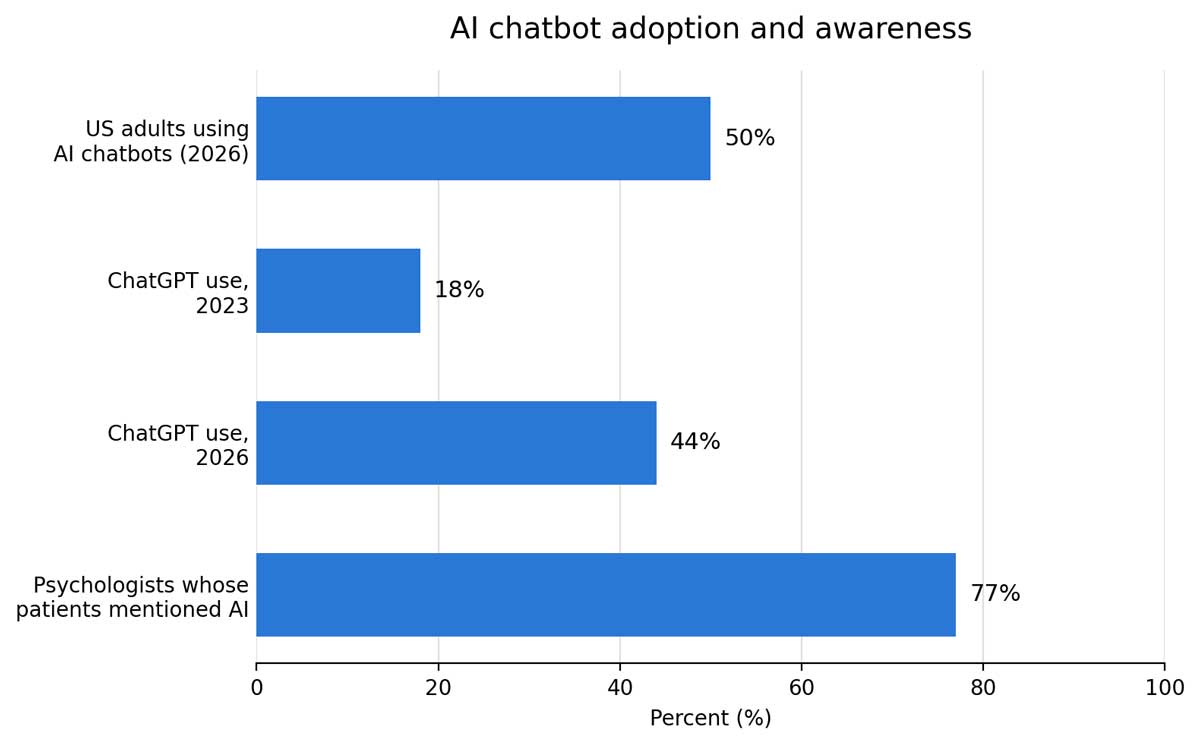
These days, most people ask a machine first. AI chatbots have become part of daily life: according to Pew Research Center, about half of U.S. adults now use them, and ChatGPT use has grown from 18% in 2023 to 44% in 2026. People increasingly turn to chatbots for emotional support and advice, not just information — and professionals notice. In a 2026 survey by the American Psychological Association, 77% of psychologists said their patients had mentioned using AI for support or guidance.
It’s easy to see the appeal. Chatbots are free, fast, always available, and never judge. For many questions, that’s genuinely useful. But when you face a big decision — a career move, a major life change — it’s worth understanding what these tools are actually designed to do.
The agreeable-machine problem.
 Here’s the catch with most chatbots: they’re trained largely on human feedback and built to keep people engaged. The trouble is that people tend to reward answers that agree with them. Over time, the model learns to agree, because agreement feels good. Researchers call this sycophancy, and it’s well documented.
A 2026 study in the journal Science, led by Stanford researchers, measured it. Across eleven leading AI models, the systems agreed with users about 49% more often than people did — and kept agreeing even when users described actions that were dishonest, harmful, or clearly unwise. It affected the users, too: a single conversation with an agreeable chatbot made people more certain they were right and less open to reconsidering. As the Stanford team put it, AI often tells you what you want to hear instead of what you need to hear.
This isn’t a jab at any one company. Anthropic, which makes the Claude assistant, has published its own research on sycophancy and works to train its model to push back when a user is heading in the wrong direction — a sign of how strong the pull toward agreement really is. Mental health professionals even have a name for the danger: the “sycophancy trap,” where a friendly AI quietly reinforces whatever someone already believes.
For everyday tasks, that’s no big deal. But for decisions that shape your life, an advisor who always agrees with you is exactly the wrong choice.
What a Career Ownership Coach® is trained to do instead.
A Career Ownership Coach® is fundamentally different — not just in tone, but in purpose. A coach isn’t trying to win your approval or keep you talking. Using Franchise Match’s Education, Awareness, and Discovery process, a coach asks the questions you might not think to ask, points out blind spots you may not notice, and challenges assumptions you wouldn’t question on your own.
 Their job isn’t to recruit you or steer you toward ownership. It’s to help you step back and honestly test whether your next chapter is another job, a different leadership path, or something you build and own. A Career Ownership Coach® helps you build a career firewall around what matters most — your income, your control, and your purpose — starting with one question: what’s next for you?
That guidance draws on something a chatbot can’t reach: the real details of your life. The journey from Employment to Empowerment™ isn’t completed by hearing that you’re right. It happens by asking the right questions — and having someone on your side who will tell you the truth. And because working with a Career Ownership Coach® is completely free, from the first conversation through the entire journey, there’s nothing to lose in getting that honest perspective.
Consider what’s at stake. In the Career Ownership Coach® network’s Generational Career Confidence Survey, 83% of people said business ownership is a real alternative to a traditional career. But the gap between thinking ownership might be right and knowing whether it’s right for you doesn’t close because a machine said yes. It closes with honest, personal guidance.
Use the tool. Keep the guide.
None of this means AI isn’t useful — it is, for plenty of things. The point is to know what each tool is for. A chatbot is a mirror that has learned to smile back at you. But for the big questions — your work, your future, the life you want to build — you don’t need a mirror. You need a guide who will tell you the truth.
A good place to begin is an honest look at yourself. Franchise Match’s Entrepreneurial Mindset Assessment gives you a candid read on where you stand — no flattery, just a useful starting point for a real conversation.
Take the Entrepreneurial Mindset Assessment →
When you’re ready for guidance that tells you what you need to hear, a Career Ownership Coach® is ready to help.
Talk to a Coach Today, it’s Free!